Nowadays, with the development of a variety of AI technology and tools, so came a new wave of discussions over marketing automation. The general consensus is: Yes, it is useful, but how exactly?
In this article, MKT Software will discuss 6 real-life case studies to explain why businesses use marketing automation and the effects it created.
I. What is marketing automation?
To understand it simply, marketing automation refers to the use of software or tools to help execute marketing tasks automatically, without needing manual human input. When implemented strategically, it becomes a growth engine that connects marketing efforts directly to measurable business outcomes.
With the rise of AI, marketing automation has become even more powerful with how it can even take care of some less intensive creative or analysis tasks.
To find out more about marketing automation’s benefits, read: 9 Valuable benefits of automation in marketing
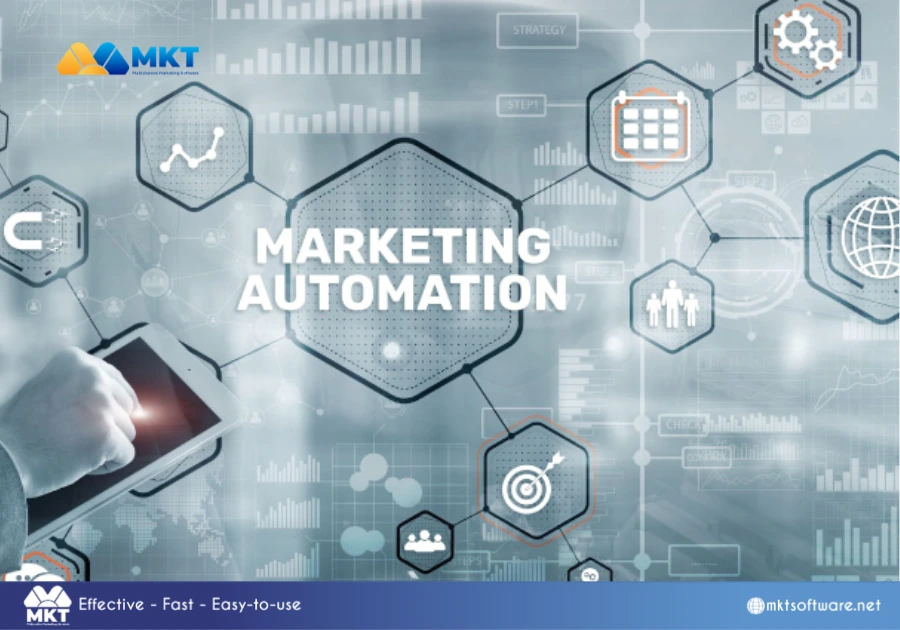
II. 6 Case studies to show why businesses use marketing automation
Simply listing the benefits of marketing automation does not fully show how powerful it can be. To better understand its real impact, it is helpful to look at practical examples.
The following 6 case studies can demonstrate how real companies have achieved measurable success by using automated marketing tools strategically:
2.1. 6 Click’s
6clicks is a rapidly expanding GRC software company who needed a unified system to manage its global onboarding, and customer communication processes. By utilizing marketing automation, 6clicks was able to streamline processes that were previously fragmented and manual.
As a result, operational growth soared with the company reporting an impressive 806% increase in key performance metrics after implementing automation and centralizing workflows.

2.2. Universal Creative Solutions
Universal Creative Solutions, a boutique marketing and operations agency, implemented marketing automation tools to improve tracking, reporting, and ROI measurement for its clients.
With this system in place, the agency was able to conduct multi-touch attribution analysis, optimize channel mix strategies, and accurately track calls and leads. As a result, they achieved a 100% increase in KPIs met – without raising client costs.
2.3. Tumblr
Tumblr wanted to strengthen engagement for its user base beyond the social platform itself. Using automation tools, they set up segmented email campaigns that delivered personalized content based on user interests.
By targeting users with curated content at the right times, Tumblr saw dramatic engagement improvements: tripled likes and a five-fold increase in re-blogs on shared content.

2.4. Red Hot Marketing
Red Hot Marketing used automation to create advanced email sequences based on segmentation, welcome messages, and behavior-based triggers. These structured workflows were designed to focus directly on revenue generation.
By automating these targeted campaigns, the company achieved a strong increase in return per message, generating approximately $1,000 in revenue for every 1,000 automated emails sent.
2.5. Shapeways
Shapeways, a leader in 3D printing services, faced difficulty making email campaigns relevant to diverse audience segments. By using automated marketing tools to streamline segmentation, Shapeways was able to send highly personalized campaigns that resonated with specific user interests.
The results were striking: Email open rates climbed by 238%, and click-through rates improved by 525%.

2.6. Salesforce
Salesforce’s internal marketing team used Sprout Social’s automation and workflow tools to manage its large social media presence, which included more than 150 channels. By automating time-consuming and repetitive tasks, the team was able to reduce manual workload significantly.
As a result, Salesforce achieved a tenfold improvement in community management efficiency and saved approximately 12,000 staff hours in just a year.
III. Should businesses use marketing automation?
Based on the real-life examples above, the impact of marketing automation is clear. However, whether it is truly “worth it” still depends on the business.
It is important to understand that automation is not a shortcut to instant success. It requires a clear strategy, clean and reliable data, and continuous optimization to deliver strong results. Without proper planning and maintenance, automation can lead to lower engagement and reduced sales rather than growth.
Generally, a brand should consider implementing marketing automation if:
- Volume of works rise as operations scale.
- Personalization becomes a necessity.
- There are multi-step processes.
- Marketing and sales need stronger alignment,…

IV. Final thoughts: Why businesses use marketing automation
No matter the objectives, marketing automation can enable brands to operate consistently and competitively in this increasingly digital environment. When supported by strong strategy and proper implementation, automation becomes a long-term investment for sustainable growth.
Read more: 6 Common mistakes in marketing automation every brands encounter