What actually separates a real Messenger blast tool from a Chrome extension that stops working the moment Meta tweaks something? Scale and survival. Sending a real campaign to thousands of Messenger contacts by hand isn’t just slow, it’s the fastest way to get an account restricted, while a properly built blast tool spreads that same volume across isolated sessions safely. MKT Care is the Windows software built for exactly that job. This guide covers where Messenger blast tools are heading in 2026, the real trade-offs of using one, the tool built to do it right, how to run it well, and the questions most operators ask before committing to one.
I. Trends In Using A Messenger Blast Tool In 2026
The clearest trend in 2026 is that a Messenger blast tool is no longer optional infrastructure for anyone doing outreach at volume – it’s the baseline. Case studies on Messenger blast campaigns report open rates as high as 80% and click-through rates near 40%, numbers email marketing simply can’t match anymore, and that gap is pulling budget and attention toward Messenger as the primary outreach channel for 2026 campaigns.
The second trend is account safety becoming the differentiator, not raw sending volume. Two years ago a Messenger blast tool competed mostly on how many messages it could push per hour; today the tools that survive are the ones built around proxy isolation and human-like send pacing, because Meta’s detection systems got dramatically better at spotting scripted bursts.
The third trend is personalization at scale. A flat, identical blast to every contact converts far worse than one where the first line, the offer, or the timing varies by segment – and the tools winning market share in 2026 are the ones that make that segmentation easy instead of requiring a separate campaign per variant.

II. Advantages And Disadvantages Of Using A Messenger Blast Tool
The advantages are substantial. A single operator can reach thousands of contacts in the time manual messaging would cover a few dozen, response data comes back centralized instead of scattered across a personal inbox, and campaigns that used to take a team a full day now run unattended overnight.
The disadvantages are real too, and worth naming honestly. A poorly built Messenger blast tool that ignores pacing and account isolation can get a Page restricted within days. Generic messaging sent at scale without any segmentation reads as spam and drags down reply rates for every future campaign, not just the current one. And tools that rely on unofficial API access rather than genuine browser automation tend to break every time Meta updates its platform, leaving a campaign stranded mid-send.
The net verdict for 2026: the advantages clearly outweigh the risk, but only when the tool is built with isolation, pacing, and segmentation as core features rather than afterthoughts. Agencies running campaigns for multiple clients feel this trade-off first – a single account restriction can take down several client campaigns at once if isolation wasn’t built in from day one.
This plays out differently by use case too. Agencies running outreach for several clients need the isolation most of all – one flagged account should never be able to take down a sibling account running the same campaign. E-commerce brands lean on the segmentation side, since a blast announcing a flash sale converts completely differently depending on whether the contact previously bought, browsed, or abandoned a cart. Local service businesses get the simplest win: a well-paced Messenger blast tool lets a two-person team follow up with every inbound lead the same day, something that was physically impossible when every reply had to be typed out one at a time between other work and other customers.
III. Introducing The Latest Messenger Blast Tool 2026 – MKT Care
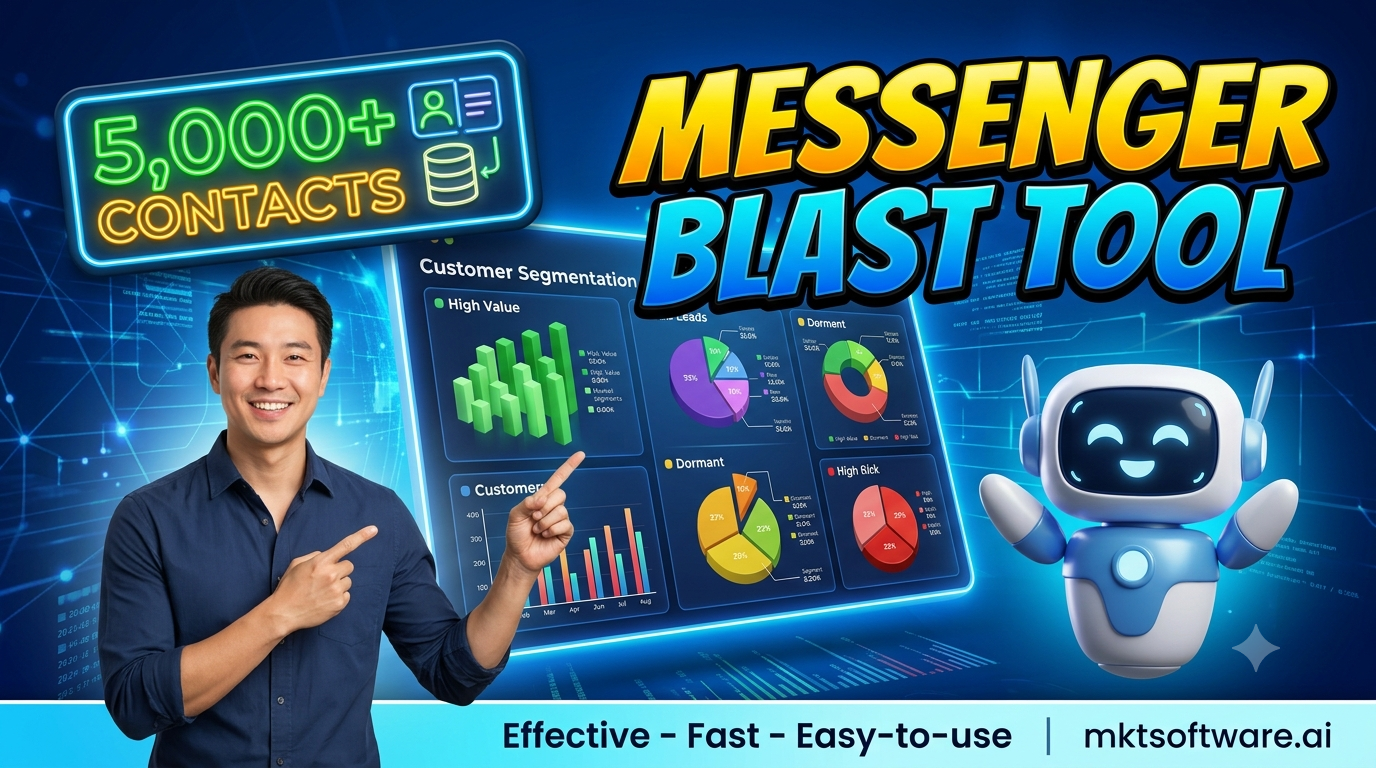
MKT Care is the 2026 release built around exactly those three requirements. It runs on Windows, drives each sending account through its own isolated browser session with residential proxy support, and paces every blast to look like natural human sending behavior instead of a scripted burst.
Campaigns are built from a segmented contact list – a CSV with tags for audience, offer, or funnel stage – so the same blast can carry three or four message variants instead of one flat broadcast. The Meta Business platform’s own native tools still assume a single account sending one conversation at a time; MKT Care is built specifically for the multi-account, multi-segment reality most real campaigns actually need.
It also pairs naturally with the rest of the growth stack. Teams running a Facebook posting bot to keep Pages active, or already using Facebook bulk messaging for follow-ups, plug MKT Care in as the outbound layer that turns new reach into direct conversations.
IV. How To Use A Messenger Blast Tool – MKT Care Effectively
Five steps separate a blast that converts from one that just empties a contact list.
- Segment before sending: split the contact list by how the lead was acquired, not just demographics – intent matters more than identity.
- Write 3–4 message variants: even a small wording change in the opening line measurably changes reply rate.
- Pace the send: spread a large blast across hours, not minutes, so sending behavior stays inside what looks human.
- Watch the first 100 replies: early response patterns reveal which variant is winning long before the full blast finishes.
- Follow up inside 24 hours: a reply that sits unanswered for two days converts at a fraction of the rate of one answered the same day.
Operators who treat a Messenger blast tool as a one-click send-everything button consistently underperform the ones who treat every blast as a small experiment – segment, vary, measure, repeat. The gap between the two groups compounds with every campaign, since the experimenters walk away from each blast with a sharper sense of what their specific audience responds to, while the one-click group learns nothing they didn’t already know.
What separates MKT Care from a scheduler adapted for Messenger is that the reply data flows back into the same dashboard that launched the campaign, tagged by segment and variant automatically. Instead of scrolling through a personal inbox trying to remember which contact got which message, an operator can see reply rate broken down by segment within minutes of a blast finishing – which is what actually makes step five, the fast follow-up, possible at volume in the first place.
V. Frequently Asked Questions About Messenger Blast Tools
Q: How many messages can a Messenger blast tool send at once?
Volume depends mainly on account count and sending pacing, not on any single hard platform limit – MKT Care spreads a large blast across multiple isolated accounts so no single account sends an unnatural burst.
Q: Is using a Messenger blast tool against Facebook’s rules?
Sending unsolicited spam is against Meta’s policies regardless of the tool; sending to contacts who already engaged with a Page, at a human-like pace, is standard outreach practice.
Q: Will a Messenger blast tool get my account restricted?
Only if it ignores proxy isolation and pacing. A properly built one is designed specifically to avoid the send patterns that trigger restrictions.
Q: Can messages be personalized inside a blast?
Yes – MKT Care supports inserting the contact’s name and segment-specific offers so a blast doesn’t have to read like one.
Q: How is a Messenger blast tool different from a chatbot?
A chatbot answers incoming messages; a blast tool initiates outbound campaigns to a contact list. Most serious operators eventually run both side by side, but they solve genuinely different problems and shouldn’t be treated as interchangeable.
Q: How long does it take to set up a first campaign?
Most operators have a first segmented blast running within an hour of installing MKT Care – the setup is importing contacts, tagging segments, and writing message variants – there’s no coding step and no waiting period before the first blast can go out.
VI. Watch The MKT Care Walkthrough
Watch the short demo below to see a Messenger blast tool run a real segmented campaign with MKT Care.
Conclusion
A Messenger blast tool in 2026 isn’t just about pushing messages out faster – it’s about doing outreach at a volume manual sending could never reach, without the account risk that comes from doing it carelessly. MKT Care handles the isolation, the pacing, and the segmentation that separate a campaign that converts from one that gets flagged, so a marketing team can run outreach at real scale without gambling the account doing it. Operators still sending Messenger campaigns one conversation at a time in 2026 aren’t just slower – they’re leaving the open rates and reply data a real Messenger blast tool would have handed them for free, every single day the manual approach continues.
Contact MKT Software
MKT Software – the leading marketing automation suite for serious operators.
- Address: 4th Floor, Stellar Garden Building, 35 Le Van Thiem Street, Thanh Xuan District, Hanoi
- Hotline: +84335648286
- WhatsApp: +84335648286
- Telegram: @vietlongmkt
- Email: [email protected]
- YouTube: @marketingtool_mktsoftware